

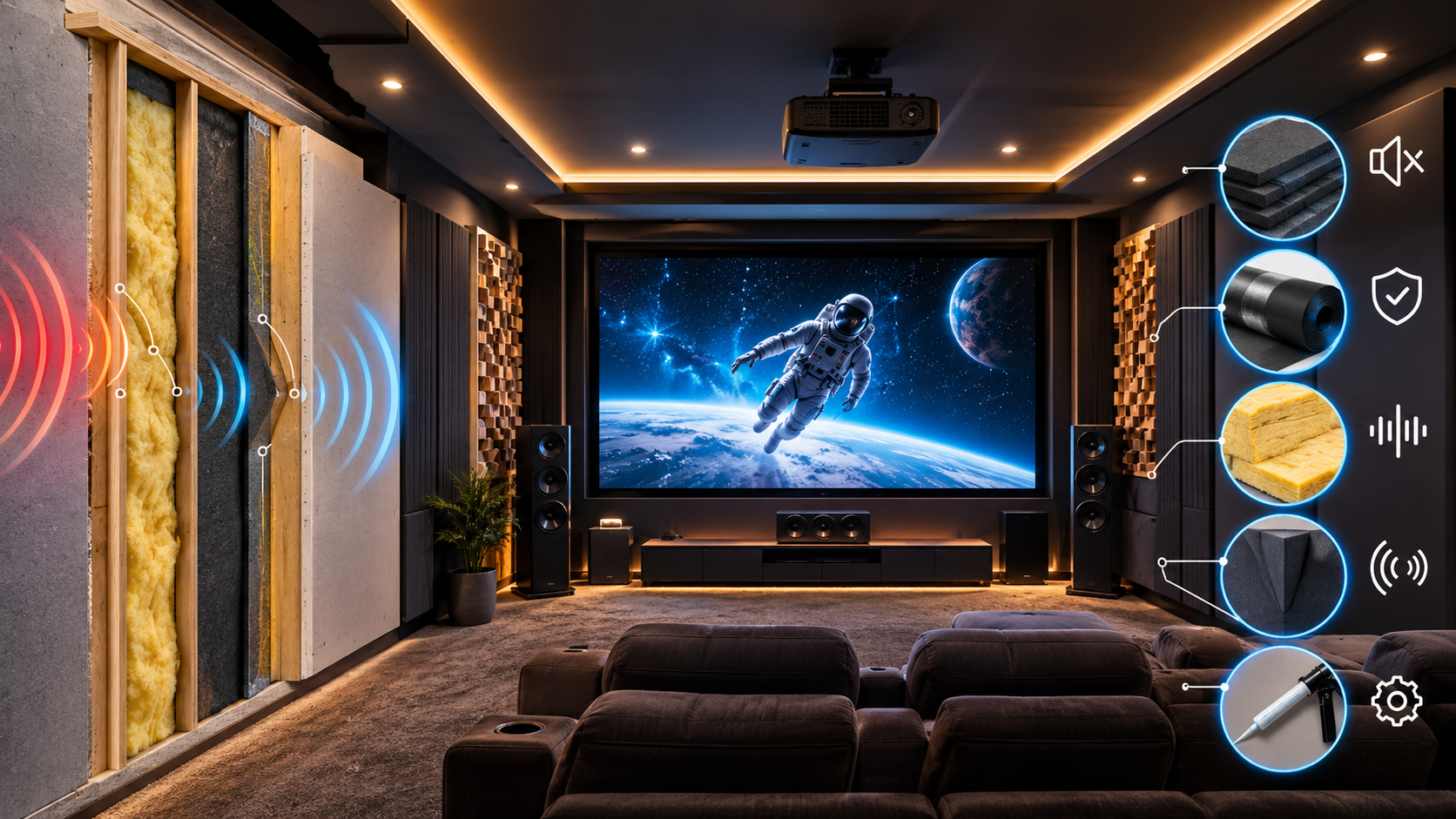
Complete Home Theatre Soundproofing Guide for Superior Sound
A home theatre is more than a large television, a powerful sound system, and comfortable seating. It is an entertainment space designed to deliver an immersive cinematic experience from the comfort of your home. However, even the most advanced speakers and audio equipment cannot perform at their best if the room has poor acoustics, unwanted noise, or excessive sound leakage.
This is where home theatre soundproofing becomes essential.
Whether you are building a dedicated cinema room, converting a spare bedroom into an entertainment space, or upgrading an existing media room, proper soundproofing helps control noise transmission, reduce unwanted disturbances, and create a more enjoyable listening environment. It also allows you to enjoy powerful movie soundtracks, dialogue, music, and special effects without unnecessarily disturbing other members of your household or neighbours.
Modern home theatre design goes beyond simply adding acoustic panels to walls. It involves understanding how sound travels, identifying weak points in a room, selecting suitable construction materials, and combining sound isolation with acoustic treatment.
In this comprehensive guide, Ultitrend explores everything homeowners need to know about home theatre soundproofing, from planning and material selection to installation techniques and modern acoustic solutions.
What Is Home Theatre Soundproofing?
Home theatre soundproofing is the process of reducing the amount of sound that enters or escapes an entertainment room. It involves improving the room’s ability to block sound transmission through walls, ceilings, floors, doors, windows, and other structural openings.
When a home theatre operates at high volume, low-frequency sound from subwoofers and bass-heavy movie scenes can travel through building structures. Without proper sound isolation, this noise may be heard in adjoining bedrooms, living areas, or neighbouring properties.
Soundproofing addresses this problem by creating barriers that reduce sound transmission.
A properly planned soundproofing system can help:
- Minimise sound leakage into adjoining rooms.
- Reduce outside noise entering the theatre.
- Improve privacy during movie screenings.
- Allow comfortable listening at different volume levels.
- Reduce disturbances caused by bass and low-frequency effects.
- Create a more controlled environment for home entertainment.
It is important to understand that soundproofing and acoustic treatment are not the same thing. Although both contribute to better home theatre performance, they solve different problems.
Soundproofing vs. Acoustic Treatment: Understanding the Difference
One of the most common mistakes homeowners make is assuming that installing acoustic foam or decorative wall panels will completely soundproof a room.
In reality, sound isolation and acoustic treatment serve different purposes.
Soundproofing focuses on preventing sound from travelling between spaces, while acoustic treatment improves how sound behaves inside the room.
| Feature | Soundproofing | Acoustic Treatment |
|---|---|---|
| Primary purpose | Reduce sound transmission | Improve sound quality inside the room |
| Main focus | Sound isolation | Sound reflection and absorption |
| Common materials | Mass-loaded vinyl, insulation, drywall, acoustic sealant | Acoustic panels, bass traps, diffusers |
| Main benefit | Less noise entering or escaping | Clearer dialogue and balanced audio |
| Typical installation | Walls, ceilings, floors, doors | Reflection points, corners, walls and ceilings |
For the best results, a home theatre should incorporate both solutions.
Soundproofing helps keep unwanted noise outside the room, while acoustic treatment creates a balanced listening environment inside it.
Why Is Soundproofing Important for a Home Theatre?
A dedicated home theatre is designed to reproduce a wide range of audio frequencies, from subtle dialogue to powerful explosions and deep bass effects. These sounds can travel beyond the room if the space is not properly isolated.
Here are some important reasons to invest in home theatre soundproofing.
1. Prevents Noise From Disturbing Other Rooms
Movie soundtracks and surround sound systems can produce considerable noise, particularly during action sequences. Soundproofing reduces the transmission of this noise into adjoining spaces.
This is particularly useful for households where different family members have different entertainment schedules.
2. Reduces External Noise
Traffic, construction, household appliances, conversations, and outdoor activities can interrupt the viewing experience.
Soundproofing measures around doors, windows, walls, and ceilings help reduce unwanted external noise and create a more controlled entertainment environment.
3. Supports Better Audio Performance
External noise can mask subtle audio details, making dialogue and quieter sound effects harder to hear.
By reducing unwanted noise entering the room, sound isolation can help listeners experience more of the detail produced by their audio equipment.
However, soundproofing alone does not eliminate echoes or guarantee accurate speaker reproduction. These improvements require appropriate acoustic treatment and speaker positioning.
4. Improves Privacy and Comfort
A sound-isolated home theatre offers greater flexibility when watching movies, gaming, or listening to music.
It allows homeowners to enjoy entertainment without constantly worrying about noise affecting other people in the house.
5. Supports a Premium Home Entertainment Experience
A well-designed cinema room combines visual comfort, lighting, seating, audio equipment, and acoustics.
Soundproofing is an important part of this overall design because it helps create a dedicated environment where entertainment can be enjoyed with fewer distractions.
Understanding How Sound Travels Through a Home Theatre
Before choosing soundproofing materials, it is important to understand how sound moves through a building.
Sound travels through the air as pressure waves. When these waves encounter walls, ceilings, floors, or other surfaces, some energy is reflected, some is absorbed, and some passes through the structure.
There are four important concepts to understand when planning a home theatre.
1. Airborne Noise
Airborne noise travels through the air before reaching a surface. Examples include:
- Movie dialogue.
- Music and soundtracks.
- Television audio.
- Conversations.
- Surround sound effects.
Airborne sound can pass through gaps around doors, windows, electrical outlets, and poorly sealed construction joints.
2. Structure-Borne Noise
Structure-borne noise occurs when vibrations travel through solid building materials.
For example, a subwoofer placed directly on a floor can cause vibrations that travel through the floor structure and into nearby rooms.
Other examples include:
- Vibrating wall panels.
- Ceiling joists.
- Floorboards.
- Speaker mounting brackets.
- Mechanical equipment.
Controlling structural vibration requires appropriate isolation techniques rather than simply adding soft materials to the room.
3. Low-Frequency Sound
Low-frequency sound, particularly deep bass, is one of the more challenging aspects of home theatre soundproofing.
Subwoofers reproduce powerful low-frequency energy that can excite walls, floors, and ceilings. These vibrations may travel through the building structure even when the room appears well insulated.
Effective low-frequency isolation often requires a combination of mass, structural separation, airtight construction, and vibration control.
4. Flanking Noise
Flanking noise travels around the intended soundproofing barrier through connected structures or alternative pathways.
For example, a soundproofed wall may still allow noise to travel through:
- Shared ceiling cavities.
- Continuous flooring.
- Adjacent walls.
- Ventilation ducts.
- Unsealed service openings.
This is why soundproofing should be planned as a complete room system rather than treating individual walls in isolation.
Best Home Theatre Soundproofing Materials
Selecting suitable materials is essential for creating an effective soundproofing system. Different products perform different functions, so material selection should depend on the room’s construction, noise levels, available space, and project budget.
Here are some commonly used materials.
1. Mass-Loaded Vinyl (MLV)
Mass-loaded vinyl is a dense, flexible sound barrier designed to add mass to walls, ceilings, and other building assemblies.
It is commonly installed behind drywall or incorporated into suitable wall and ceiling constructions.
Benefits:
- Adds sound-blocking mass without requiring an extremely thick barrier.
- Flexible enough for different installation applications.
- Can be incorporated into existing renovation projects.
- Helps reduce airborne sound transmission when installed correctly.
MLV is not a complete soundproofing solution by itself. Its performance depends on the surrounding construction, sealing, and installation quality.
2. Mineral Wool and Acoustic Insulation
Mineral wool is widely used in wall and ceiling cavities because of its sound-absorbing properties.
It helps reduce resonance within cavities and can improve the acoustic performance of appropriately designed wall and ceiling assemblies.
Benefits:
- Absorbs sound energy within cavities.
- Helps reduce cavity resonance.
- Suitable for many wall and ceiling applications.
- Can be combined with resilient channels and multiple drywall layers.
Mineral wool does not independently block all sound transmission. Its effectiveness depends on the complete wall or ceiling assembly.
3. Acoustic Drywall
Acoustic drywall products are designed to improve sound isolation through specialised construction and material composition.
They may be used as part of multi-layer wall or ceiling assemblies.
Benefits:
- Can increase the mass of a partition.
- Helps improve sound isolation when combined with other construction methods.
- Provides a finished surface for interior design.
- Can be integrated into new builds and renovations.
The performance of an entire wall assembly is more important than the specification of a single drywall product.
4. Resilient Channels and Isolation Clips
Resilient channels and isolation clips help separate drywall from the underlying framing structure.
This separation reduces direct mechanical connections that can transfer vibrations between building components.
Benefits:
- Reduces certain structure-borne sound transmission paths.
- Helps decouple drywall from framing.
- Can improve the performance of properly designed wall and ceiling assemblies.
Installation must follow the manufacturer’s specifications. Incorrect screw placement or accidental contact with framing can compromise the isolation system.
5. Acoustic Sealant
Small gaps can become significant sound leakage pathways.
Acoustic sealant is used to seal joints and openings around soundproofed construction assemblies while maintaining flexibility.
Common applications include:
- Wall-to-ceiling joints.
- Wall-to-floor connections.
- Electrical box openings.
- Drywall perimeter joints.
- Gaps around construction penetrations.
A continuous, airtight barrier is an important part of effective sound isolation.
6. Acoustic Foam Panels
Acoustic foam panels are primarily used to absorb sound reflections inside a room.
They can help reduce flutter echo and certain mid- and high-frequency reflections.
Benefits:
- Lightweight and easy to install.
- Available in different shapes and thicknesses.
- Useful for controlling selected interior reflections.
- Available in different finishes and designs.
However, standard acoustic foam should not be confused with soundproofing material. It does not provide the mass or structural isolation required to significantly block sound transmission through walls.
7. Bass Traps
Bass traps are designed to help manage low-frequency energy inside a room.
They are commonly positioned in room corners, where low-frequency pressure variations can be particularly problematic.
Benefits:
- Help control low-frequency resonances.
- Improve bass consistency across listening positions.
- Can reduce excessive bass build-up.
- Support a more balanced listening experience.
Bass traps improve internal acoustics rather than directly soundproofing the room.
How to Soundproof a Home Theatre Room: Step-by-Step Guide
A successful home theatre soundproofing project starts with a proper assessment of the room.
Instead of purchasing materials immediately, identify where noise enters and escapes, evaluate the existing construction, and determine which areas need improvement.
Step 1: Assess the Existing Room
Start by inspecting the room’s walls, ceiling, floor, doors, windows, and ventilation openings.
Identify potential sound leakage points and consider how the room connects to surrounding spaces.
Pay particular attention to:
- Shared walls with bedrooms or living rooms.
- Thin interior partitions.
- Hollow-core doors.
- Large windows.
- Suspended ceilings.
- Floor cavities.
- Electrical and plumbing penetrations.
Also consider the location of subwoofers and speakers because their positioning can affect structural vibration.
For a more accurate assessment, a professional acoustic consultant can evaluate the room’s existing construction and recommend suitable sound isolation strategies.
Step 2: Soundproof the Walls
Walls are one of the most important areas to address because they often separate the home theatre from adjoining rooms.
There are several ways to improve wall sound isolation, depending on the existing construction.
Common approaches include:
- Adding suitable cavity insulation.
- Installing resilient channels or isolation clips.
- Using multiple layers of drywall.
- Incorporating mass-loaded vinyl where appropriate.
- Sealing perimeter joints and service penetrations.
- Constructing a separate decoupled wall where greater isolation is required.
For new construction, a properly designed double-stud or independently framed wall can provide a higher level of isolation than simply adding another layer of drywall to an existing partition.
Step 3: Soundproof the Ceiling
Ceilings require special attention when the home theatre is located beneath bedrooms or another occupied floor.
Noise can travel through ceiling cavities, joists, lighting openings, and structural connections.
Consider the following measures:
- Install appropriate insulation within ceiling cavities.
- Use resilient channels or isolation clips where specified.
- Add additional drywall layers as part of a designed assembly.
- Seal openings around light fixtures and service penetrations.
- Consider a decoupled ceiling for more demanding projects.
If the room is located on an upper floor, the floor assembly above may also require treatment.
Step 4: Improve Floor Sound Isolation
Floor construction plays an important role in controlling vibration and impact noise.
For home theatres located above other rooms, sound isolation may require a combination of resilient underlayments, floating floor systems, and structural considerations.
Useful options include:
- Acoustic underlayment beneath suitable floor finishes.
- Resilient flooring systems.
- Carpet and quality underlay for comfort and some impact-noise reduction.
- Isolation platforms beneath subwoofers.
- Professionally designed floating floor assemblies.
Carpet can improve comfort and reduce certain high-frequency reflections, but it should not be treated as a substitute for structural sound isolation.
Step 5: Upgrade Doors and Windows
Doors and windows are common weak points in otherwise well-constructed rooms.
A hollow-core door, for example, can allow considerably more sound through than a properly sealed, solid-core door.
Consider these improvements:
- Replace hollow-core doors with suitable solid-core alternatives.
- Install perimeter acoustic seals.
- Add an automatic door bottom or threshold seal.
- Seal gaps around the door frame.
- Use properly designed acoustic glazing where necessary.
- Improve window frame and perimeter sealing.
A well-sealed door can make a noticeable difference, particularly when the existing door has visible gaps.
Step 6: Seal Every Opening and Gap
Even small openings can compromise a sound isolation system.
Inspect the room carefully for gaps around electrical outlets, switches, cable entries, ventilation openings, and construction joints.
Use appropriate acoustic sealants and approved acoustic electrical boxes or putty pads where required.
Never block ventilation or cover electrical components in a way that creates safety risks. Any modifications should comply with applicable electrical, fire, and building requirements.
Step 7: Install Acoustic Treatment
Once the sound isolation measures are planned, focus on the room’s internal acoustic performance.
This is where acoustic panels, bass traps, and diffusers become useful.
Common treatment locations include:
- First reflection points on side walls.
- The front wall around the speaker system.
- Rear-wall reflection areas.
- Ceiling reflection points.
- Room corners.
The objective is not to eliminate every reflection. A home theatre needs a controlled balance of direct and reflected sound to maintain a natural listening experience.
Step 8: Test and Fine-Tune the Room
After installation, evaluate the room’s performance.
Check whether noise is still escaping, whether external sounds are noticeable, and whether the audio system produces consistent sound across the seating area.
Useful assessment methods include:
- Listening tests.
- Speaker calibration.
- Frequency-response measurements.
- Room impulse-response measurements.
- Professional sound isolation testing where required.
For larger projects, measuring sound transmission before and after construction can help determine whether the soundproofing assembly is performing as intended.
How to Control Bass and Subwoofer Vibrations
Low-frequency sound is often the most challenging part of home theatre soundproofing.
A subwoofer can create powerful vibrations that travel through floors, walls, and ceilings. This can cause noise in adjoining rooms even when other soundproofing measures are in place.
Here are several ways to manage bass-related issues.
Use an Isolation Platform
An isolation platform beneath a subwoofer can help reduce direct mechanical vibration transfer into the floor.
Choose a platform designed for the subwoofer’s weight and intended application.
Position Subwoofers Carefully
Subwoofer placement influences bass distribution throughout the room.
Avoid assuming that placing a subwoofer in a corner will always produce the best results. Experiment with placement and measure bass response at the main listening positions.
Treat Low-Frequency Room Modes
Room dimensions create resonances at particular frequencies, commonly called room modes.
These can produce uneven bass response, where some seats experience excessive bass while others experience weaker bass.
Bass traps and carefully designed acoustic treatment can help manage these issues.
Use Proper Structural Isolation
For demanding installations, a professionally designed floating floor, isolated wall, or decoupled ceiling may be necessary.
These systems are particularly relevant when powerful subwoofers are used in rooms that share structural elements with bedrooms or neighbouring properties.
Best Acoustic Treatment Strategies for Superior Home Theatre Sound
Soundproofing limits sound transmission, but acoustic treatment determines how sound behaves within the theatre.
A well-treated room can make dialogue easier to understand, improve tonal balance, and create a more consistent listening experience.
1. Treat First Reflection Points
First reflection points are locations where sound from the speakers bounces off walls or ceilings before reaching the listener.
Absorption panels placed at appropriate reflection points can reduce unwanted reflections and improve imaging.
2. Add Bass Traps to Room Corners
Bass energy can accumulate unevenly throughout a room.
Suitable bass traps help control low-frequency resonances and improve bass consistency.
3. Use Diffusers Where Appropriate
Diffusers scatter sound reflections rather than simply absorbing them.
They can be useful in certain rear-wall and larger-room applications where maintaining a sense of spaciousness is desirable.
4. Manage Ceiling Reflections
Ceiling reflections can influence clarity and surround sound perception.
A properly positioned ceiling absorber or acoustic cloud may help control unwanted reflections, particularly in rooms with hard ceilings.
5. Balance Absorption and Reflection
Overusing acoustic absorption can make a room sound unnaturally dry.
A good design balances absorption, diffusion, and reflective surfaces according to the room dimensions, speaker configuration, and intended listening experience.
Modern Home Theatre Soundproofing Trends to Consider
Home entertainment technology continues to evolve, and modern home theatre designs increasingly combine advanced audio systems, smart controls, and architectural integration.
The following trends are worth considering when planning a new cinema room.
1. Dedicated Acoustic Room Design
Rather than treating acoustics as an afterthought, homeowners are increasingly considering sound isolation and room treatment during the initial design stage.
This approach allows walls, ceilings, doors, ventilation, and speaker locations to be planned together.
2. Invisible Acoustic Solutions
Acoustic treatment does not always need to look like a traditional recording studio.
Fabric-wrapped panels, concealed absorbers, integrated wall treatments, and carefully selected decorative finishes can help maintain a premium interior design.
3. Smart Home Theatre Integration
Modern home theatres can integrate audio, lighting, motorised curtains, displays, and other entertainment components into a connected control system.
For example, a movie-watching scene can coordinate dimmed lighting, curtain positioning, and entertainment equipment through a compatible smart home platform.
4. Advanced Multi-Channel Audio Systems
Immersive audio formats such as Dolby Atmos have increased interest in ceiling speakers, surround channels, and carefully planned speaker layouts.
These systems make speaker positioning, ceiling construction, acoustic reflections, and vibration control particularly important.
5. Measurement-Based Acoustic Calibration
Instead of relying entirely on guesswork, modern home theatre projects can use measurement microphones, room correction systems, and professional acoustic analysis.
This helps identify frequency-response problems and improve system calibration.
6. Multi-Purpose Entertainment Rooms
Many homeowners want a room that works as a cinema, gaming space, music room, or family entertainment area.
Flexible acoustic treatments, concealed equipment, integrated storage, and adaptable lighting can support these different uses.
Common Home Theatre Soundproofing Mistakes to Avoid
Even high-quality materials may deliver disappointing results if the room is not designed and installed correctly.
Avoid these common mistakes.
| Mistake | Why It Causes Problems | Better Approach |
|---|---|---|
| Using acoustic foam as the only soundproofing material | Foam mainly absorbs internal reflections | Use a properly designed sound isolation assembly |
| Ignoring doors and windows | Gaps allow sound to escape | Install suitable doors and acoustic seals |
| Forgetting ceiling cavities | Sound can travel through connected structures | Assess ceiling and floor assemblies |
| Using insufficient sealing | Small openings create leakage paths | Seal construction joints and penetrations |
| Ignoring low-frequency vibrations | Bass can travel through building structures | Use appropriate structural isolation |
| Overusing acoustic panels | The room may sound excessively dead | Balance absorption and diffusion |
| Incorrect resilient channel installation | Mechanical connections can compromise isolation | Follow the specified installation design |
| Blocking ventilation openings | Can create airflow and safety problems | Design acoustically treated ventilation |
A successful soundproofing project depends on the complete construction system rather than a single product or material.
How Much Does Home Theatre Soundproofing Cost?
The cost of home theatre soundproofing depends on room dimensions, existing construction, desired sound isolation, selected materials, and installation complexity.
A simple improvement project may focus on door seals, gap sealing, and basic acoustic treatment. A dedicated cinema room requiring decoupled walls, isolated ceilings, specialised doors, and floating floors will require a significantly larger investment.
The following table provides a general budgeting framework rather than fixed market prices.
| Project Level | Typical Scope | Cost Considerations |
|---|---|---|
| Basic | Door seals, gap sealing, selected acoustic panels | Lower material and installation requirements |
| Intermediate | Insulated wall improvements, additional drywall, acoustic treatment | Moderate construction and labour requirements |
| Advanced | Decoupled walls, isolated ceilings, specialised doors and vibration control | Higher material and installation requirements |
| Premium | Complete room-within-a-room construction, floating floor, dedicated acoustic design | Highest design and construction complexity |
Before setting a budget, consider the following:
- Existing wall and ceiling construction.
- Room size and ceiling height.
- Required level of sound isolation.
- Type and number of speakers.
- Subwoofer power and placement.
- Acoustic material specifications.
- Electrical and ventilation modifications.
- Professional design and installation costs.
For accurate budgeting, request a room assessment and a detailed scope of work before purchasing materials.
Should You Hire a Professional for Home Theatre Soundproofing?
Some basic improvements, such as installing door seals or adding selected acoustic panels, may be suitable for DIY projects.
However, complete soundproofing is more complicated because sound can travel through multiple interconnected building components.
Professional assistance is particularly valuable when:
- Building a dedicated home cinema from scratch.
- Soundproofing a room next to bedrooms or neighbouring properties.
- Installing powerful subwoofers.
- Modifying walls, floors, or ceilings.
- Creating a room-within-a-room structure.
- Integrating surround sound and ceiling speakers.
- Addressing persistent low-frequency noise.
A professional can assess the existing room, recommend suitable construction assemblies, identify flanking transmission paths, and coordinate sound isolation with the home theatre equipment and interior design.
This can help prevent expensive mistakes and reduce the likelihood of having to rebuild parts of the room later.
Home Theatre Soundproofing Checklist
Before completing your home theatre project, use this checklist to review the most important areas.
- Inspect existing walls, floors, and ceilings.
- Identify external noise and sound leakage paths.
- Assess shared walls and connected structural elements.
- Select suitable insulation and sound isolation materials.
- Plan door and window improvements.
- Seal construction gaps and service penetrations.
- Address subwoofer and speaker vibration.
- Install appropriate acoustic panels and bass traps.
- Plan ventilation without compromising sound isolation.
- Check speaker positioning and listening locations.
- Calibrate the audio system.
- Test the completed room for noise transmission and acoustic performance.
Create a Better Home Cinema Experience with Ultitrend
A high-quality home theatre is the result of thoughtful planning, the right equipment, and an environment designed to support exceptional entertainment.
Soundproofing helps control noise transmission, while acoustic treatment improves the way audio behaves within the room. When these elements are considered alongside speaker placement, lighting, seating, and smart home integration, the result is a more comfortable and immersive entertainment space.
Whether you are planning a new dedicated cinema room or upgrading an existing entertainment area, understanding the principles of sound isolation and room acoustics is an important first step.
At Ultitrend, we believe a well-designed home entertainment environment should bring technology, comfort, and thoughtful design together. Explore home theatre and smart entertainment solutions to create a space that makes every movie night more enjoyable.
Frequently Asked Questions
1. What is the best way to soundproof a home theatre room?
The best approach is to combine mass, airtight sealing, structural decoupling, and suitable cavity insulation. Depending on the room, this may include additional drywall layers, mineral wool, isolation clips, acoustic sealant, and improved doors. Acoustic panels and bass traps should then be used to improve sound quality inside the room.
2. Does acoustic foam soundproof a room?
No. Standard acoustic foam is designed primarily to absorb sound reflections inside a room. It can help reduce echo and improve listening conditions, but it does not provide the mass or structural isolation needed to significantly prevent sound from passing through walls, floors, or ceilings.
3. How can I stop home theatre bass from disturbing other rooms?
Start by identifying how bass vibrations are travelling through the building. An isolation platform beneath the subwoofer may help reduce direct vibration transfer. More demanding problems may require decoupled walls, isolated floor systems, or structural modifications. Bass traps can also help control low-frequency resonances inside the theatre, although they do not replace sound isolation.
4. What is the best insulation for home theatre walls?
Mineral wool is a commonly used option for sound absorption within wall cavities. However, effective sound isolation also depends on wall mass, framing arrangement, decoupling, airtightness, and the number of drywall layers. The complete wall assembly should be considered rather than selecting insulation alone.
5. Can I soundproof an existing home theatre without major renovation?
Yes, although the achievable improvement depends on the existing construction and the source of the noise. Door seals, perimeter sealing, window improvements, and selected acoustic upgrades may help. Significant reductions in sound transmission, particularly at low frequencies, may require more extensive structural work.
6. Should I soundproof the ceiling or walls first?
There is no universal order. It depends on where sound is escaping and how the room connects to adjoining spaces. If the theatre shares a wall with a bedroom, the wall may need priority. If there is an occupied room directly above, the ceiling or floor assembly may be more important. A full-room assessment is recommended.
7. Do carpets help with home theatre soundproofing?
Carpets and underlays can reduce some impact noise and absorb certain high-frequency reflections. They can also make the room more comfortable. However, they do not provide the structural isolation needed to block airborne sound and deep bass effectively.
8. Is professional home theatre acoustic treatment necessary?
Professional acoustic treatment is not essential for every small entertainment room, but it can be valuable for dedicated cinemas and advanced surround sound installations. Acoustic measurements and professional planning help identify room resonances, reflection problems, and speaker calibration issues.
9. What is a room-within-a-room soundproofing system?
A room-within-a-room system uses an independently constructed internal room to reduce direct structural connections with the existing building. It may include isolated walls, a decoupled ceiling, and a floating floor. It is often considered for high-performance home cinemas where substantial sound isolation is required.
10. Does soundproofing improve Dolby Atmos performance?
Soundproofing does not directly improve Dolby Atmos decoding or speaker performance. However, reducing external noise and controlling structural vibration can create a better listening environment. Proper speaker placement, ceiling treatment, room dimensions, and audio calibration remain essential for an immersive Dolby Atmos experience.
Subscribe to our
newsletter.
Get valuable strategy, culture, and brand insights straight to your inbox.
By signing up to receive emails from Motto, you agree to our Privacy Policy. We treat your info responsibly. Unsubscribe anytime.