

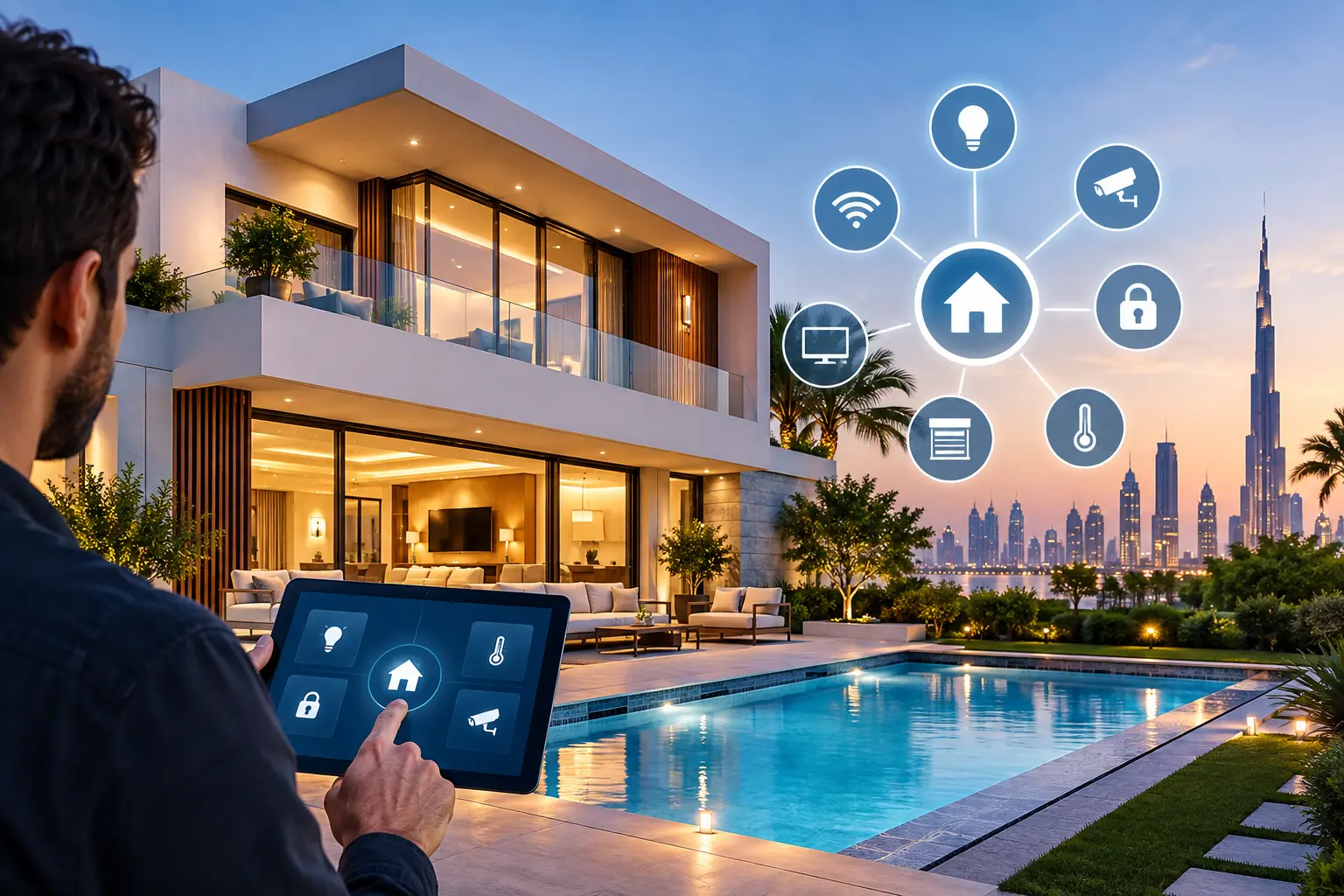
How to Choose a Home Automation Company in Dubai for a Villa Project
Quick answer: Pick a home automation company in Dubai by checking four things, in this order. One, it holds a valid Dubai trade licence covering low current or security system work, and it is SIRA registered if it will install CCTV or access control. Two, it is a certified KNX partner with programmers on its own payroll, not subcontracted labour. Three, it will hand you as built drawings, the ETS project file and system passwords in your name at handover. Four, it offers a written service agreement with a named response time. Brand and price come after those four, not before.
A villa is a different job from an apartment. You have multiple distribution boards, an outdoor perimeter, a gate, a pool, irrigation, a driveway, sometimes a guest annexe and staff quarters. Cable runs are long, the network has to cover a garden, and one weak link in the design shows up as a light that flickers or a camera that drops offline two years after the family moved in.
The companies that quote for this work in Dubai range from serious engineering firms to two man operations with a van. On a proposal document they can look almost identical. Below is how to tell them apart before you sign anything.
Start with the stage your villa is at
The right company for a villa still on paper is not always the right company for one you already live in. Match the stage first, then shortlist.
| Stage of your villa | What the company must be able to do | What to send them |
| Design stage, architect appointed | Read architectural and MEP drawings, issue a low current layout, coordinate with the consultant, produce a lighting calculation | Floor plans, reflected ceiling plans, electrical drawings |
| Under construction, walls open | Supervise first fix cabling, mark conduit routes on site, sign off containment before plaster | Site access, construction programme, contractor contact |
| Built and handed over, not occupied | Survey existing conduits, plan a hybrid of wired and wireless, work around finished ceilings | Site visit, photos of DB boards and ceiling voids |
| Occupied villa, retrofit | Work in an occupied home, phase the job room by room, protect finishes | Site visit and a list of what annoys you today |
If a company gives the same answer and the same quotation for all four situations, it is selling boxes rather than designing a system. Our guide on home automation during construction versus after construction goes through the cost difference between these stages in detail.
The nine checks that actually separate companies
1. Verify the trade licence and the activity on it
Ask for a copy of the Dubai trade licence and read the listed activities. A company doing villa automation should show electromechanical, low current or security systems work on the licence. A general trading licence is not the same thing. If the scope includes CCTV, intercom or access control, ask whether the company is registered with SIRA, the Dubai body that regulates security companies and sets CCTV standards in the emirate. Enforcement is strictest on commercial premises and private villas are treated more leniently, but the licence is still a fast, free way to separate a registered engineering business from a freelance installer with a printed brochure.
For anything that touches the mains side of your electrical installation, check that the electrical work will be carried out by a contractor enrolled with DEWA. Fire alarm and life safety systems fall under Dubai Civil Defence approval, so if your villa design includes them, ask who is submitting.
2. Insist on an open protocol, and check the certification behind it
KNX and DALI are open standards. Any certified integrator can service or extend the system later. A closed, app based ecosystem locks you to one supplier, and if that supplier closes or loses your programmer, you are rebuilding from scratch.
If a company says it is KNX certified, that claim is verifiable. KNX partner status is issued to companies that have completed training at a certified centre, and partners are listed publicly on the KNX Association website. Ask for the company name as it appears there and look it up yourself. Ask a follow up too: how many certified programmers are on the payroll, and will one of them be on your project. A firm with one certified name and eight uncertified technicians is a different risk from a firm with four.
Read our comparison of KNX versus wireless systems and KNX versus DALI versus wireless if you want the technical reasoning behind this.
3. Ask who does the design, and ask to see one
A serious proposal for a villa includes drawings, not just a price list. Ask to see a sample design pack from a past villa project, with names removed. You are looking for a low current layout, a lighting circuit schedule, a rack elevation, a network diagram and a device schedule per room.
If the lighting scope includes fittings, ask for a Dialux calculation showing lux levels and colour rendering per space. Companies that offer lighting design as a real service will have these ready in minutes.
4. Find out who is actually on site
Ask directly: are your electricians and programmers employed by you, or supplied by a manpower company. Then ask who supervises them daily and who commissions the system at the end. On villa projects the gap between a well designed system and a badly installed one is almost always labour. Cables pulled through the wrong conduit, unlabelled cores and a DB board with no schedule are problems that surface at commissioning, when it is expensive to fix.
5. Test their thinking on the villa specific parts
This is where apartment installers get exposed. Raise these points and listen to how quickly they have an answer:
- Cable distances from the main rack to the far end of the plot, and whether fibre or additional network cabinets are needed
- Outdoor rated devices for gate, driveway, pool area and garden, and how they handle Dubai summer heat and humidity
- Wi Fi coverage in the garden, terraces and pool house without dead zones, built on a wired backbone
- Where the rack lives, how it is cooled and ventilated, and what happens in a power cut
- Whether the villa needs more than one automation bus segment across multiple distribution boards
- Irrigation, gate motors, water features and pool pumps brought into the same interface
- Camera coverage of the full boundary wall, not just the front door
Our pages on outdoor automation and home networking cover why villas fail on these two points most often, and the article on why every Dubai villa needs a professional home network explains the backbone issue in plain terms.
6. Agree the handover pack in writing, before you sign
This is the single most skipped item in the Dubai market and the one that costs owners the most later. Put it in the contract. At handover you should receive:
- As built drawings showing final cable routes and device positions
- The ETS project file for a KNX system, in your name, on a drive you keep
- Admin passwords for every controller, panel, camera recorder and network device
- An IP address schedule for everything on the network
- Labelled distribution boards with a printed circuit schedule
- Product warranty documents and model numbers
- A short written or filmed handover session for the family and the house staff
If a company hesitates on the ETS file or the passwords, that is not a technical objection. It is a commercial strategy to keep you dependent. Walk away.
7. Read the service agreement, not the warranty slogan
“Lifetime support” means nothing without terms. Ask what the annual maintenance contract costs, what it includes, what the response time is for a fault, whether support is on site or remote, and what happens when a device fails out of warranty and the model is discontinued. Ask how many engineers the company has available for service calls, and whether the person who programmed your villa is still with the company.
8. Read the quotation line by line
A vague one page quotation is a warning, not a convenience. A proper bill of quantities lists device quantities per room, cable types and lengths, containment, the rack and its contents, programming hours, commissioning and the exclusions. Exclusions matter most. Find out who pays for civil work, chasing walls, making good, false ceiling cutting, power to the rack and network cabling to the gate house.
When you compare two quotations, compare point counts and scope, not totals. One may exclude the outdoor scope entirely. Our breakdown of smart home automation cost in Dubai shows what drives the number up or down.
9. Visit a finished villa, ideally an old one
Anyone can show a photo gallery. Ask to visit a completed villa project, and specifically ask for one commissioned two or three years ago rather than last month. A new system looks perfect. A three year old system tells you whether the company builds things that keep working and whether the client still takes their calls. Browse the projects portfolio first so you know what to ask to see.
Red flags to walk away from
| What you hear | What it usually means |
| “We will share the design after you pay the advance” | There is no design team |
| “The app is our own proprietary platform” | You are locked in permanently |
| “You do not need drawings for a villa” | First fix will be improvised on site |
| Price is far below every other quote | Scope is missing, usually outdoor and network |
| “We keep the programming file for security reasons” | You cannot change supplier later |
| No office address, only a mobile number | No service capability after handover |
| Brand names but no certification numbers | Reseller, not an integrator |
| Pressure to sign the same week | Standard tactic on villa owners in build stage |
Ten questions to ask on your first call
- What is on your trade licence, and are you SIRA registered for security systems?
- Are you a certified KNX partner, and under what company name are you listed?
- How many certified programmers do you employ directly?
- Which of your engineers will be assigned to my villa?
- Can I see a design pack and a bill of quantities from a similar villa?
- Do I receive the ETS project file and all admin passwords at handover?
- What is your annual maintenance cost and your fault response time?
- Which parts of the work do you subcontract?
- Can I visit a villa you completed at least two years ago?
- What is excluded from this quotation?
If you get clear answers to all ten, you are dealing with an engineering company. If you get brochures, you are dealing with a reseller.
What a well run villa project looks like
| Phase | What happens | Rough duration |
| Consultation and site survey | Requirements, room by room scope, budget banding | 1 to 2 weeks |
| Design and proposal | Low current drawings, device schedule, bill of quantities | 2 to 3 weeks |
| First fix | Conduits, back boxes, cable pulling, containment sign off | Runs with the build programme |
| Second fix | Devices, panels, keypads, rack build | 2 to 4 weeks after finishes |
| Programming and commissioning | Scenes, schedules, testing every circuit | 1 to 3 weeks |
| Handover and training | Documentation pack, family walkthrough, staff training | 1 to 2 days |
| Service period | AMC, remote support, expansions | Ongoing |
Timelines stretch on large plots in communities like Emirates Hills, Palm Jumeirah, Dubai Hills Estate, Al Barari and District One, where plot size and outdoor scope add weeks that companies often leave out of their first estimate. Ask for the programme in writing.
Talk to an engineer before you shortlist
UltiTrend designs and installs KNX and DALI systems for villas across Dubai and the wider UAE, working from the drawing stage with architects, consultants and main contractors. If you are comparing quotations right now, send us your drawings and we will tell you what is missing from them. Get in touch or read more about our smart home automation and security systems work.
Frequently asked questions
1. How much does home automation cost for a villa in Dubai?
Villa costs depend on point count, not floor area alone. A lighting and curtain system for a four bedroom villa sits in a very different band from a full system with AV, security, network and outdoor control. Ask for pricing per point and per room so you can compare quotations fairly. Our full cost guide breaks the ranges down.
2. Should I choose KNX or a wireless system for a villa?
For a villa, wired KNX is usually the better choice. Long cable runs, thick walls, outdoor zones and a high device count are exactly the conditions where wireless systems become unreliable. Wireless makes more sense in a finished villa where opening ceilings is not an option.
3. Do I need SIRA approval for CCTV in my own villa?
Private residences are generally treated differently from commercial premises, where SIRA rules are enforced strictly. Even so, using a SIRA registered company is a useful filter, because it confirms the business is properly licensed for security work in Dubai rather than operating informally.
4. When should I appoint the automation company?
At design stage, before electrical drawings are finalised. Bringing an integrator in after the walls are closed limits what is possible and raises the cost of the same result. The second best time is during first fix, while conduits are still accessible.
5. Can I change companies later if I am unhappy?
Only if your system is built on an open standard and you hold the programming file and passwords. With KNX, another certified partner can take over. With a closed proprietary system, you may have to replace hardware. This is why the handover pack matters more than the brand.
6. Is it cheaper to buy the devices myself and hire an installer?
Usually not. You lose the warranty chain, the installer takes no responsibility for device faults, and no one owns the outcome when something fails. Supply and install under one contract keeps accountability in one place.
7. How long does a villa automation project take?
From first meeting to handover, a typical villa runs three to six months, mostly governed by the construction programme rather than the automation work itself. Programming and commissioning at the end need one to three weeks and should not be compressed.
Subscribe to our
newsletter.
Get valuable strategy, culture, and brand insights straight to your inbox.
By signing up to receive emails from Motto, you agree to our Privacy Policy. We treat your info responsibly. Unsubscribe anytime.