

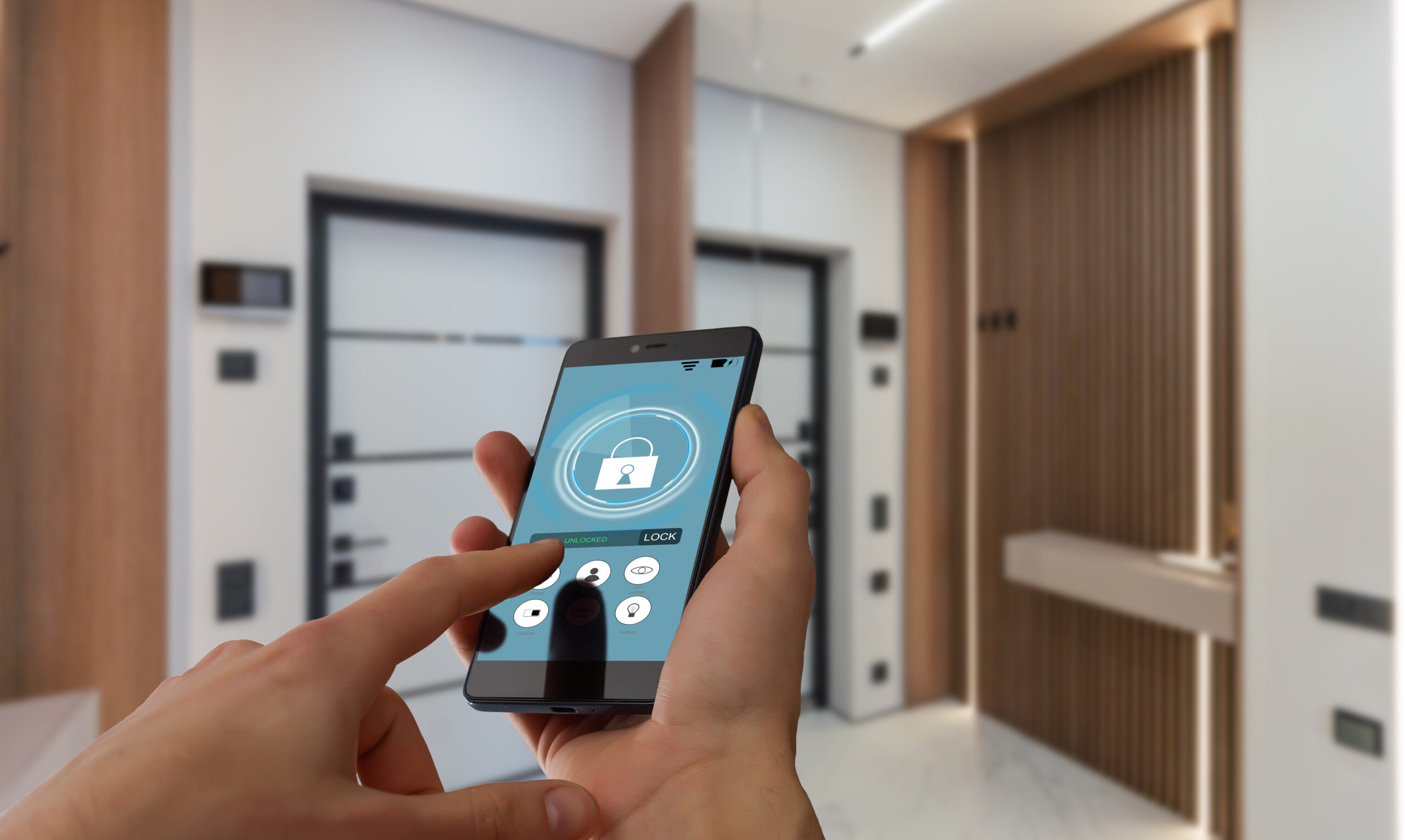
Remote Home Monitoring in Dubai: Smart Property Security
Short answer: Remote home monitoring in Dubai means watching and controlling your property from your phone while you are somewhere else. A complete setup covers four things at once: who is at the door, what is happening inside, whether water or fire is a problem, and whether the power and AC are still running. For private villas and apartments, you do not need SIRA approval to install it, but UAE privacy law still applies to where your cameras point.
Most people in Dubai think about home monitoring as cameras. Cameras are the part you see. They are not the part that saves you money.
The claim we deal with most often is not a break-in. It is a villa owner landing back in Dubai after six weeks away and finding a burst AC drain line has been running quietly into a ceiling void since July. A camera would have shown an empty hallway the whole time. A twenty dirham water sensor under the AHU would have sent an alert on day one.
What remote home monitoring actually covers
A properly designed system in a Dubai home has five layers. Each one answers a different question.
1. Perimeter and entry. Outdoor cameras, video intercom at the gate or front door, and a smart lock. This tells you who arrived, when, and whether they got in. Yale and similar locks give you a per-user code, so the cleaner’s code and the maintenance company’s code are separate entries in a log.
2. Interior presence. Motion sensors and interior cameras in circulation spaces. In a villa this is usually the entrance hall, stairwell and corridor, not bedrooms. Ajax and comparable alarm panels handle this with battery backup and their own cellular path, so a cut internet line does not kill the alarm.
3. Water and fire. Leak sensors under every AHU, water heater, kitchen sink and washing machine point. A shut-off valve on the main feed if the plumbing allows it. Fire is already handled at national level in villas by Hassantuk, which we cover below.
4. Environment. Temperature and humidity sensors in each zone, plus feedback from the AC system itself. This is the layer almost nobody installs, and it is the one that catches summer damage before it becomes a repaint.
5. Power and network. An alert when DEWA supply drops, when the UPS kicks in, or when your router goes offline. Without this layer, every other layer can fail silently and you will think everything is fine because your app is showing you a frozen last-known state.
If your current system only does layer one, you have a doorbell, not monitoring.
Why Dubai is a different problem to solve
Generic home security advice is written for houses that sit in mild weather with an owner ten minutes away. Neither is true here.
Homes sit empty for long stretches. Summer travel, extended family visits, and owners who live overseas mean a large share of Dubai properties are unoccupied for weeks at a time. Nothing about a locked door tells you what is happening behind it.
The climate attacks empty homes. DEWA has said that switching the AC off during a long holiday cuts energy use but lets heat and humidity build up, which can produce fungus, bad smells and damage to furniture and electronics. One UAE home services company estimated that up to 30 per cent of homes may develop some form of mould buildup inside the AC system in a given year. The usual guidance is to leave the AC running around 26 to 28 degrees in fan or auto mode during a long absence and keep indoor humidity under 60 per cent. You can only confirm that is actually happening if something is reporting back to you.
Villa plumbing behaves differently. In most villas here, water comes from a roof or underground tank and is pushed through the system by a pump rather than arriving under mains pressure. A pump that keeps running against a leak will empty a tank and keep going. Blocked condensate drain lines are one of the most common causes of indoor water leaks in Dubai properties.
Short-term rental adds a compliance layer. If the property is licensed as a holiday home, you are not just watching an asset. You are handling other people’s data under DET rules, and that changes what you are allowed to record.
The rules: what you can and cannot install
This is the section most articles skip, and it is the one that gets owners into trouble.
Do villas and apartments need SIRA approval?
No, not for a purely private residence. Private homes are generally exempt from SIRA approval, though cameras must not intrude on neighbours or public space. SIRA rules bind commercial premises open to the public, and those systems have to meet placement, image quality and retention standards, commonly a minimum of 31 days of footage.
Exempt does not mean you should ignore the standard. We build residential systems to the same design logic anyway, because the reason SIRA cares about camera height, angle and backlight is that badly placed cameras produce footage nobody can use. If you ever need to hand a clip to the police, a wide shot of a shadow is worth nothing.
Where your cameras are allowed to point
This is the hard line. Article 44 of Federal Decree-Law No. 34 of 2021 makes it a criminal offence to use technology to invade someone’s privacy, including recording conversations, photographing people without consent, and tracking a person’s location electronically. Penalties start at six months’ detention and fines from AED 150,000 to AED 500,000. There is no general public-place exception in UAE law, and truth is not a defence, because the offence is the unauthorised capture and disclosure itself.
In practice, for a Dubai home:
- Angle cameras down and inward so the frame ends at your boundary wall
- Do not cover a neighbour’s garden, windows, balcony or pool
- Do not put cameras in bedrooms, bathrooms or maid’s quarters
- Use privacy masking in the camera firmware for any part of the frame you cannot avoid
- Do not post footage of an identifiable person in a community WhatsApp group, even if they were in the wrong
The last point catches people constantly. Sharing the clip can put you on the wrong side of the law faster than whatever was on it.
If the property is a licensed holiday home
Interior cameras in guest areas are off the table. Recording guests inside a unit sits directly against both the privacy law and DET’s operating standards. Keep monitoring to the entry door, and treat everything else as environmental: leak sensors, smoke, temperature, door and window contacts.
You also carry data duties. DET requires licensed holiday homes to report every check-in and check-out on the day it happens through the Holiday Home system, and to keep guest records securely for at least five years. Your DET permit number has to be on the listing itself, and platforms check it before the listing goes live. Any camera or access log tied to a guest becomes part of that record, so store it properly.
Fire monitoring is already mandatory for villas
UAE Cabinet Resolution No. 61 of 2020 requires all existing and under-construction residential villas to install Hassantuk, the Ministry of Interior fire alarm system, with a deadline of 1 January 2024. Detectors report to a 24/7 command centre, which phones the registered contact to verify the alert before passing it to Civil Defence with the exact location. More than 43,000 units had been fitted at the time of reporting, with the system credited with stopping over 400 real fires. It also has a Bukhoor mode so incense does not trigger false alarms. At launch, the Ministry gave an indicative figure of around AED 5,814 for a four-bedroom villa, covering installation plus two years of monitoring and maintenance, varying with property size.
Treat Hassantuk as your fire layer and build the rest of the system around it rather than duplicating it.
Cloud cameras or a local system: which one for a Dubai villa
This is the decision that determines whether your system still works in year five.
Consumer cloud cameras are cheap, fast to install, and completely dependent on three things staying alive: your Wi-Fi, your internet line, and the manufacturer’s server. Lose any one and you have no footage at all, not even locally. Subscription pricing also tends to move after you have committed.
A local NVR with remote access records to a drive in your property and streams to you over a secured connection. Internet drops, recording continues. You own the footage. You are not paying per camera per month to keep it.
A wired, integrated system goes further. Cameras, intercom, locks, alarm, leak sensors and climate all report into one controller, and one app shows you the whole picture. This is the approach we take on KNX and comparable open-protocol projects, because it survives brand changes. If you want the longer version of that argument, we wrote it up in KNX vs Wireless Smart Home Systems.
For most Dubai villas the right answer is a hybrid: wired backbone and local recording for anything that matters, wireless sensors for the cheap, battery-powered layers like leak and door contacts.
The part people underspend on is the network. Remote monitoring is only as reliable as the connection carrying it. A single consumer router in a marble villa with three floors and thick walls will drop half your sensors by August. Proper access point placement, a wired backbone, and a UPS on the router and NVR are not luxuries here, they are the difference between a system that reports and a system that goes quiet the week you leave. We cover the build in networking and IT infrastructure.
How to set up remote monitoring, in order
- Walk the property and list the failure points. Every water source, every entry point, every AC unit, the DB board, the tank and pump. This list is your sensor plan.
- Fix the network first. Wired backbone, access points sized to the building, UPS on the router, NVR and gateway. Do this before buying a single camera.
- Place cameras at entries and approaches only. Gate, front door, garage, garden access. Check the frame of each one against the neighbour boundary and mask what you cannot avoid.
- Add the alarm layer with its own path. A panel with cellular backup and battery, so a cut line does not disable it.
- Put leak sensors under every water source. AHUs, heaters, kitchen, laundry, bathrooms. Add an automatic shut-off valve if your plumbing supports it.
- Add temperature and humidity sensors per zone. Set alerts to fire if any zone crosses 30 degrees or 60 per cent humidity.
- Confirm Hassantuk is active and the registered phone number is current. An old number means nobody answers verification, which delays the response.
- Set up access, not just viewing. A smart lock with time-limited codes lets a maintenance visit happen while you are abroad without handing anyone a key.
- Test it while you are still in the country. Trigger every sensor. Drop the internet and confirm the alarm still reports. Check that the app alerts actually reach your phone on roaming.
- Write down who responds. A system that alerts you in a different time zone is useless unless someone in Dubai can be at the property within a couple of hours.
Step ten is the one that turns monitoring into protection.
What drives the cost
Pricing depends on property size, whether the building is already wired, and how many layers you want. The things that actually move the number:
- Number of cameras and whether they are wired or wireless
- Local recording capacity and retention period
- Whether cabling can be run in existing conduit or needs chasing
- Network rebuild scope, which is often the largest single line
- Number of leak, climate and contact sensors
- Integration into an existing KNX or automation system versus a standalone install
- Ongoing monitoring subscriptions, if any
A retrofit into a finished villa costs more than the same system specified during construction, which is why we prefer to be in the drawings before the walls close. For a breakdown of how automation budgets typically split, see how much smart home automation costs in Dubai.
Five mistakes we see repeatedly
Cameras only. Four cameras and nothing else. You get footage of the damage, not warning of it.
Wi-Fi everything. Battery sensors on a weak signal go offline one by one and nobody notices, because a silent sensor looks exactly like a sensor with nothing to report.
No power backup. DEWA blips, the router reboots, the NVR comes back without reconnecting, and the system is dark for a week.
Cameras pointed over the wall. Usually done with good intentions to cover the street. It exposes you to a privacy complaint and can turn a security measure into a legal problem.
Nobody local. Alerts arriving to a phone in London at 3am with no keyholder in Dubai achieve nothing.
Before you travel: a short checklist
- AC left running in fan or auto mode, around 26 to 28 degrees, in every zone including closed rooms
- AC serviced, filters cleaned, condensate drain lines checked and clear
- Leak sensors tested and battery levels confirmed
- All cameras and sensors showing online in the app
- Alarm armed in away mode with cellular backup verified
- Hassantuk contact number current
- Smart lock codes issued to cleaner and maintenance, with expiry dates
- One local keyholder briefed, with your alert list forwarded to them
- Router, NVR and gateway on a UPS
- Water main shut off if nobody will need access, provided this does not disable your fire or AC systems
Ready to monitor your property properly?
UltiTrend designs and installs integrated monitoring for villas and apartments across Dubai, built on KNX, DALI and other open standards so you are never locked into one brand. We work from the drawing stage with architects and contractors, and we document every system so the engineer who answers your call in two years knows your installation.
Talk to our engineers or read more about our smart home security systems.
FAQ
1. Do I need a licence or SIRA approval to install cameras at my Dubai home?
Private residences are generally exempt from SIRA approval. Commercial premises are not. Even when exempt, your cameras must not capture neighbouring property or public areas in a way that intrudes on other people.
2. Is it legal to record my front gate in Dubai?
Yes, if the frame stays on your own property and access route. The problem starts when the camera covers a neighbour’s garden, windows or balcony, or when you share footage of an identifiable person. Article 44 of the 2021 Cybercrimes Law carries at least six months’ detention and fines of AED 150,000 to AED 500,000 for privacy breaches committed through technology.
3. Can I put cameras inside my holiday home rental?
Not in guest areas. Interior recording of guests conflicts with UAE privacy law and DET operating standards. Limit cameras to the entrance and rely on leak, smoke and climate sensors inside.
4. How long should I keep footage?
Commercial premises under SIRA are commonly required to retain 31 days. Private homes have no fixed requirement, but 30 days is a sensible target because insurance and police enquiries rarely happen the same week as the incident.
5. Will my monitoring work if the internet goes down?
Only if it was designed to. A local recorder keeps recording. An alarm panel with cellular backup keeps reporting. Cloud-only cameras stop completely and record nothing.
6. What is the single most useful sensor in a Dubai home?
A water leak sensor under the AC indoor unit. Blocked condensate drains are among the most common causes of indoor water leaks here, and the damage compounds every day it goes unnoticed.
7. Should I switch off the AC when I travel?
No. DEWA has warned that heat and humidity in a closed home can cause fungus, odours and damage to furniture and electronics, and the usual advice is to run the AC at around 26 to 28 degrees in fan or auto mode and keep humidity below 60 per cent.
8. Is Hassantuk the same as a home security system?
No. Hassantuk is the mandatory Ministry of Interior fire alarm system for UAE villas, required under Cabinet Resolution No. 61 of 2020. It handles fire. Intrusion, water, climate and access are separate layers you add yourself.
9. Can I control everything from one app?
Yes, if the system is integrated from the start on an open protocol. Bolting together five brands with five apps is what most people end up with, and it is why they stop checking.
Subscribe to our
newsletter.
Get valuable strategy, culture, and brand insights straight to your inbox.
By signing up to receive emails from Motto, you agree to our Privacy Policy. We treat your info responsibly. Unsubscribe anytime.