

Smart Home Automation for New Villa Construction: What to Wire Before the Walls Go Up
Every year we get calls from villa owners in Dubai who moved in six months ago and now want to add proper Home Automation for a new villa. We can usually still do it, but it means opening ceilings, chasing walls, and paying two or three times what it would have cost if the wiring had gone in during construction. This is the single most common regret we hear from clients, and it is completely avoidable.
If you are at the drawing stage of a new villa, or about to break ground, this is the right time to be reading this. Once the concrete is poured and the walls are plastered, your options shrink fast, and your budget grows.
Why Timing Matters More Than Almost Anything Else
Home automation systems like KNX rely on dedicated wired cabling running from a central panel to every light switch, sensor, keypad and control point in the house. That cabling has to run inside the walls, under the floor screed, or through the ceiling void, and all of that needs to happen before finishing works start.
If you wait until after handover, an integrator either has to retrofit using wireless devices, which come with real reliability tradeoffs we cover in our piece on KNX vs DALI vs wireless systems, or open up finished walls and ceilings to run new cable, which is disruptive, messy and expensive.
The good news is that getting this right does not require you to become a wiring expert. It just means bringing an automation specialist into the conversation at the same stage you bring in your architect and MEP contractor, not after.
The Stage Where This Actually Happens
Most people assume smart home planning is a finishing touches conversation, something you think about once you are choosing light fittings and paint colors. In reality, the useful window opens much earlier.
Concept and design stage
This is when your architect is laying out rooms, ceiling heights and general circulation. It is also the best time to flag which rooms will need automated lighting, motorized shading, multi-room audio, or a home cinema, so wall and ceiling voids can be planned with enough space for cabling and back boxes.
MEP drawing stage
Once mechanical, electrical and plumbing drawings are being finalized, this is where your automation integrator should be sitting alongside your electrical consultant. This is when lighting circuits, KNX bus cabling, AV wiring, network cabling and security cabling all get marked onto the drawings properly, room by room.
First fix electrical stage
This is the point of no return. Once first fix electrical work starts, meaning conduits and cabling are being run through the structure before plastering, any automation wiring that was not planned gets much harder and more expensive to add. If your integrator has not been involved by this stage, you are already behind.
We work directly with architects, interior designers and contractors from the early drawing stage for exactly this reason. You can read more about our approach on our smart home automation.
What Actually Needs to Be Wired Before the Walls Close
Here is a practical breakdown of what should be planned and cabled during construction, room by room.
Lighting
Every light fitting that will be dimmed, scened or automated needs a home run cable back to a KNX actuator, or a DALI line if you are running a DALI lighting layer. This includes downlights, wall washers, cove lighting, feature pendants and any exterior lighting like garden or facade lights.
Shading and curtains
Motorized shades and curtains need power cabling to the motor location plus a control cable back to the automation panel. This has to be planned before ceiling pockets are built, since retrofitting a motorized shade into a closed ceiling void later is genuinely difficult.
HVAC integration
If you want your air conditioning integrated into scenes, like a bedroom that automatically dims lights and adjusts temperature at bedtime, this needs coordination between your automation integrator and your HVAC contractor, since certain AC units need specific interface modules wired in during installation.
AV and home cinema
Speaker cabling, HDMI runs and any dedicated home cinema wiring should be planned before ceilings and walls close. This is one of the most common regrets we see, homeowners who want a proper multi-room audio setup or home cinema after the fact, only to find there is no clean way to run speaker cable without visible conduit. Our AV solutions covers what a properly planned system looks like.
Security and access control
CCTV cabling, intercom wiring, smart lock wiring and any perimeter sensors for gates or outdoor areas all need to be run during first fix, particularly for larger villas where camera positions are tied to structural columns or boundary walls. Our security systems goes into more detail on what a full setup includes.
Networking backbone
A villa full of smart devices, cameras and streaming services needs a wired network backbone, not just a single router in the hallway. This means running structured cabling to a central network cabinet, with access points placed to cover every floor and outdoor area. Trying to run a whole villa on Wi-Fi alone is one of the most common causes of unreliable smart home performance, and it is something we cover in more depth on our networking and IT.
Outdoor automation
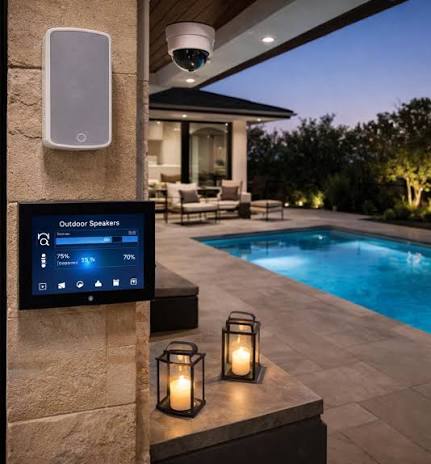
Pools, gardens, majlis areas and outdoor kitchens often get left out of the planning conversation, then added as an afterthought. Outdoor lighting, irrigation control, pool equipment and outdoor AV all need weatherproof cabling planned into the landscaping design before hardscaping begins. Take a look at our outdoor automation for what this typically involves.
A Simple Room by Room Checklist
If you are meeting with your architect or contractor soon, here is a short list of questions worth raising for each major room:
- Will this room need dimmable or scene controlled lighting, and where should the keypad or touch panel go?
- Are there any motorized shades or curtains, and has ceiling pocket space been allowed for the motor?
- Does this room need built in speakers, and has cable been planned for that before the ceiling closes?
- Will this space need a network access point, and is there a cable run back to the central cabinet?
- Are there any security cameras, sensors or smart locks tied to this room or its access points?
Going through this list room by room with your contractor before first fix begins will save you from most of the costly retrofits we see later.
What Happens If You Are Already Past This Stage
If your villa is already under construction and walls are closing soon, it is not too late to have this conversation, but the window is closing. Getting an automation integrator on site now, even for a quick walkthrough with your contractor, can still catch a few important cable runs before it becomes a much bigger job later.
And if handover has already happened, do not panic either. Retrofitting is more involved, but a combination of accessible wired points where possible and carefully chosen wireless devices where not can still get you a solid working system. It just will not be quite as clean or as future proof as planning it from day one.
Bringing an Integrator In Early Pays for Itself
The honest reality is that automation wiring is a tiny fraction of a villa’s total construction cost, but it is one of the easiest things to overlook because it does not show up as a visible line item the way tiles or fittings do. Every villa we have worked on where the integrator was involved from the drawing stage ended up with a cleaner installation, fewer surprises, and a system that was genuinely easier and cheaper to expand later.
If you are currently at the design or MEP stage of a new villa in Dubai or anywhere in the UAE, this is the right time to bring in a specialist, not after the walls go up. Our team works alongside architects and contractors from day one to make sure lighting, shading, AV, security and networking are all planned properly before construction moves past first fix. You can get in touch with our engineers here to talk through your project, or explore our full range of solutions to see how everything ties together.
Subscribe to our
newsletter.
Get valuable strategy, culture, and brand insights straight to your inbox.
By signing up to receive emails from Motto, you agree to our Privacy Policy. We treat your info responsibly. Unsubscribe anytime.