

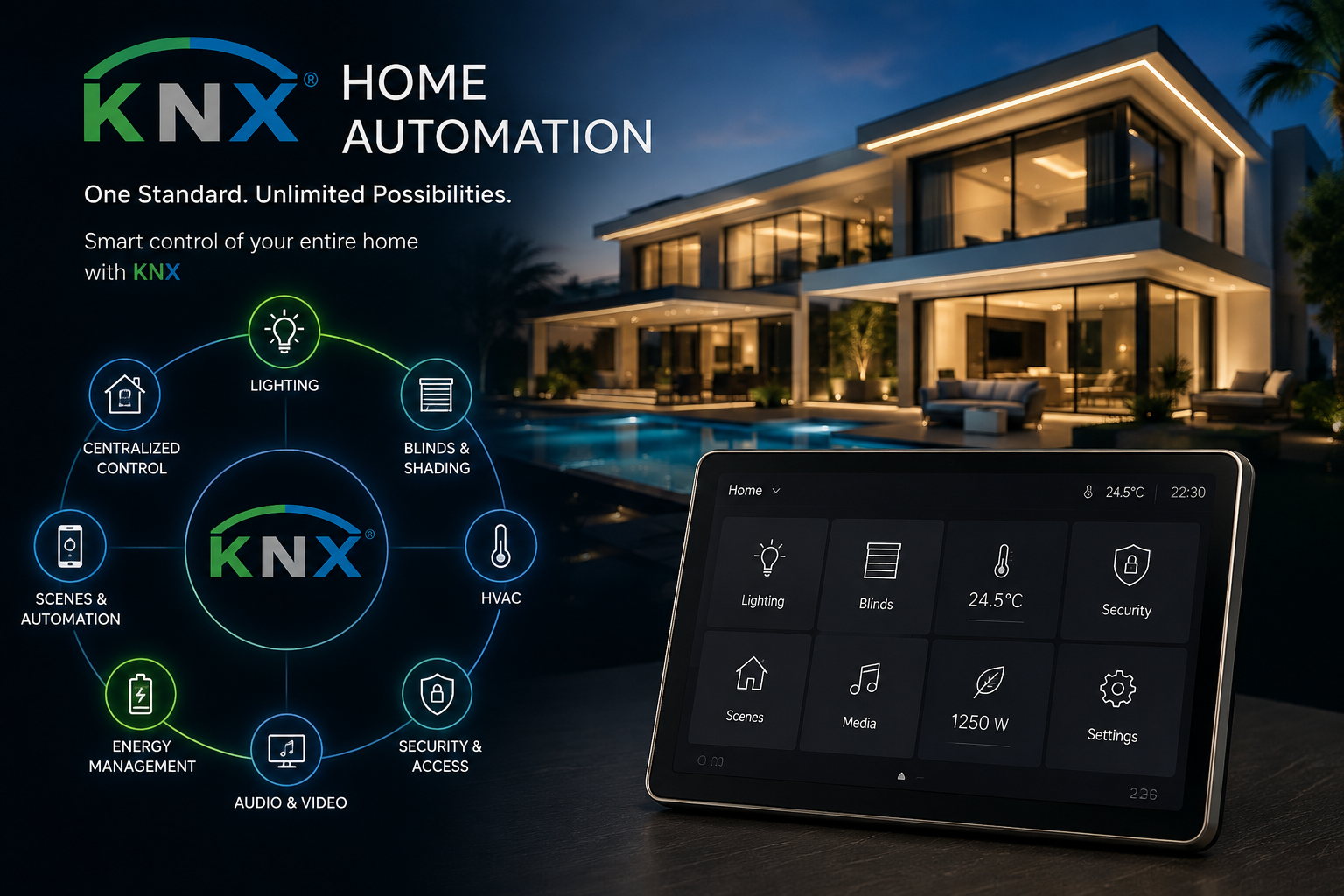
What Is KNX Home Automation and Why Is It Used in Luxury Villas?
Quick answer: KNX is an open, manufacturer independent standard for building automation that lets lighting, air conditioning, curtains, security and audio visual systems communicate through one wired network instead of running as separate apps. It is used in luxury villas because it supports products from hundreds of manufacturers, scales to large properties with hundreds of circuits and multiple HVAC zones, and lets homeowners build custom scenes such as Good Night, Away or Movie that control several systems at once. Unlike wireless smart home kits, KNX is wired, so it is typically planned during villa construction rather than added afterward.
Anyone building or renovating a luxury villa in Dubai eventually runs into the same question: how do you get lighting, air conditioning, curtains, security and entertainment to actually work together instead of sitting on five separate apps? For most high end properties, the answer is KNX.
KNX is the open standard behind a large share of the world’s serious home automation projects, and it is the backbone UltiTrend uses to design smart villas across Dubai. Here is what it actually is, how it works, and why it tends to be the right fit for large, architecturally ambitious homes.
What Is KNX Home Automation?
KNX home automation is an open, manufacturer independent standard for building automation. It gives lighting, climate control, shading, security, audio visual equipment and other building systems a common language, so they can be programmed to respond to each other rather than operating as isolated gadgets.
Because it is an open standard rather than a single brand’s ecosystem, KNX certified components come from hundreds of manufacturers worldwide. That means a villa’s automation system can be built from best in class products for each function, whether that is DALI lighting control, a BMS integration, or hardware from Lutron, Basalte, Zennio or ABB, rather than being locked into whatever one company happens to sell.
In practice, KNX turns a villa into a set of coordinated scenes instead of a wall of individual switches. A single “Good Night” command can dim or switch off lighting, adjust the AC, close motorised curtains, and arm relevant security zones in one action. An “Away” scene can do the same for an empty house: lights off, blinds closed, cooling reduced, security engaged.
How a KNX System Actually Works
A KNX installation is built from three basic components:
Sensors detect something, such as motion, daylight levels or a switch press. The KNX bus carries that information between devices over a dedicated wired network. Actuators carry out the response, such as switching a light, opening a curtain motor or adjusting a valve.
A motion sensor in a hallway can trigger lighting without anyone touching a switch. A wall keypad can call an entire scene rather than one circuit. A thermostat in a home cinema can talk to the AV system so cooling adjusts automatically when a film starts.
Systems are planned and programmed using ETS, the standard KNX configuration software, which lets an integrator design the entire villa’s logic before a single device is wired in. This is what allows smart home automation in Dubai to be built around how a family actually lives in the property, rather than forcing them to adapt to generic presets.
What Can KNX Control in a Villa?
Lighting
Individual circuits, dimming, scenes, schedules, motion based triggers and daylight harvesting can all sit inside one system. A “Dinner” scene might dim the dining area, bring up accent lighting and turn off anything unnecessary elsewhere in the villa.
Climate Control
In a Dubai climate, cooling is not optional, and running it efficiently across a large villa matters. KNX can manage AC by room, by occupancy and by schedule, so unused wings are not being cooled around the clock.
Motorised Curtains and Blinds
Shading can respond to time of day, sunlight levels or a scene, while still allowing manual override from a keypad or app.
Security and Access
Access control, door and window sensors, smart locks, intercoms and CCTV can be brought into the smart security layer as everything else, rather than run as a separate, disconnected system.
Audio Visual
Home cinemas and multi room audio can be tied into scenes, so selecting “Movie” dims the lights, closes the blinds and brings the AV system to life together.
Energy Management
Coordinating lighting, cooling and shading through one system makes it possible to monitor and reduce the energy load a large villa generates, which becomes significant once a property has dozens of circuits and multiple HVAC zones running at once.
Why KNX Home Automation Specifically Suits Luxury Villas in Dubai
A small apartment with a handful of connected devices rarely needs KNX. A large villa is a different problem entirely, and this is where its architecture earns its keep.
It is not tied to one manufacturer. With certified products available from hundreds of manufacturers, a villa’s system can combine the best available lighting control, keypads, HVAC interfaces and sensors, instead of being restricted to a single brand’s product range.
It scales with the size of the project. KNX handles anything from a modest home to a mansion with hundreds of lighting points, multiple HVAC zones and several separate buildings, so the system grows with the property instead of running out of headroom.
It allows real customisation. Scenes and behaviours are programmed around the household, not selected from a generic template. A morning routine, an away mode or a movie night can all be tailored circuit by circuit.
It holds up over time. No system is future proof forever, but an open, multi manufacturer standard reduces the risk of being stuck when one company changes direction or discontinues a product line. A villa built on KNX today can add energy monitoring, solar integration or expanded security later without ripping out the existing infrastructure.
KNX vs Wireless Smart Home Systems
Wireless systems are a reasonable choice for a small home or someone who wants basic control over a few lights and plugs. They are quick to install and do not require rewiring.
Luxury villas usually outgrow that approach quickly. Wired systems are more reliable at scale, less prone to interference across a large floor plan, and better suited to new build projects where the electrical infrastructure can be planned from day one. The right question is not which system is cheapest, but which one matches the size, complexity and long term plans for the property.
Why Planning Comes Before Construction Finishes
The best time to design a KNX system is before the electrical and MEP work is locked in. That is when an integrator can plan lighting circuits, switch and sensor placement, HVAC zoning, curtain motors, security wiring, networking and AV cabling as part of the build itself, rather than retrofitting it afterward.
Bringing in a smart home specialist during the design stage, alongside the architect, interior designer and MEP consultant, means the technology gets built into the villa rather than bolted on once the walls are finished.
KNX Home Automation FAQs
What does KNX stand for in home automation?
KNX is the name of the standard itself, maintained by the KNX Association, and is used as the common term for the wired building automation protocol rather than an acronym homeowners need to decode.
Is KNX better than wireless smart home systems like Alexa or Google Home?
KNX and consumer wireless systems solve different problems. Wireless kits suit small homes and simple device control. KNX suits large villas that need reliable, wired control across many circuits, HVAC zones and integrated systems, with less risk of interference or dropped connections.
How much does KNX home automation cost for a villa in Dubai?
Cost depends on villa size, the number of circuits and zones, and which systems are integrated, since KNX is built per project rather than sold as a fixed package. A written scope from an integrator such as UltiTrend is the only reliable way to price a specific villa.
Can KNX be added to an existing villa, or does it need new construction?
KNX can be retrofitted into an existing villa, though it is more straightforward and less disruptive to plan it during new construction or a full renovation, when wiring is already exposed.
Which brands work with KNX?
KNX is compatible with certified products from hundreds of manufacturers, including DALI lighting systems, Lutron, Basalte, Zennio and ABB, which is why UltiTrend can design a system around the best components for each function rather than one brand’s product line.
Is KNX Right for Your Dubai Villa?
If the project involves multiple HVAC zones, extensive lighting, motorised shading, a home cinema, integrated security and any expectation of scaling up later, KNX is generally the strongest fit. For a smaller property with modest requirements, a simpler wireless setup can still make sense.
UltiTrend designs and installs KNX based automation for luxury villas across Dubai, covering lighting, HVAC, motorised shading, security, AV and networking as one integrated system. If you are planning a new villa or renovating an existing one, talk to us early, while there is still time to build automation into the design rather than add it after the fact.
Planning a smart villa in Dubai? Get in touch with UltiTrend to discuss the right KNX approach for your project.
Subscribe to our
newsletter.
Get valuable strategy, culture, and brand insights straight to your inbox.
By signing up to receive emails from Motto, you agree to our Privacy Policy. We treat your info responsibly. Unsubscribe anytime.